Best Travel Baseball Stats App for Families
By Carl Andrews · July 1, 2026
A travel baseball stats app should be fast, affordable, and easy from the bleachers. Here’s what families and coaches should actually look for.
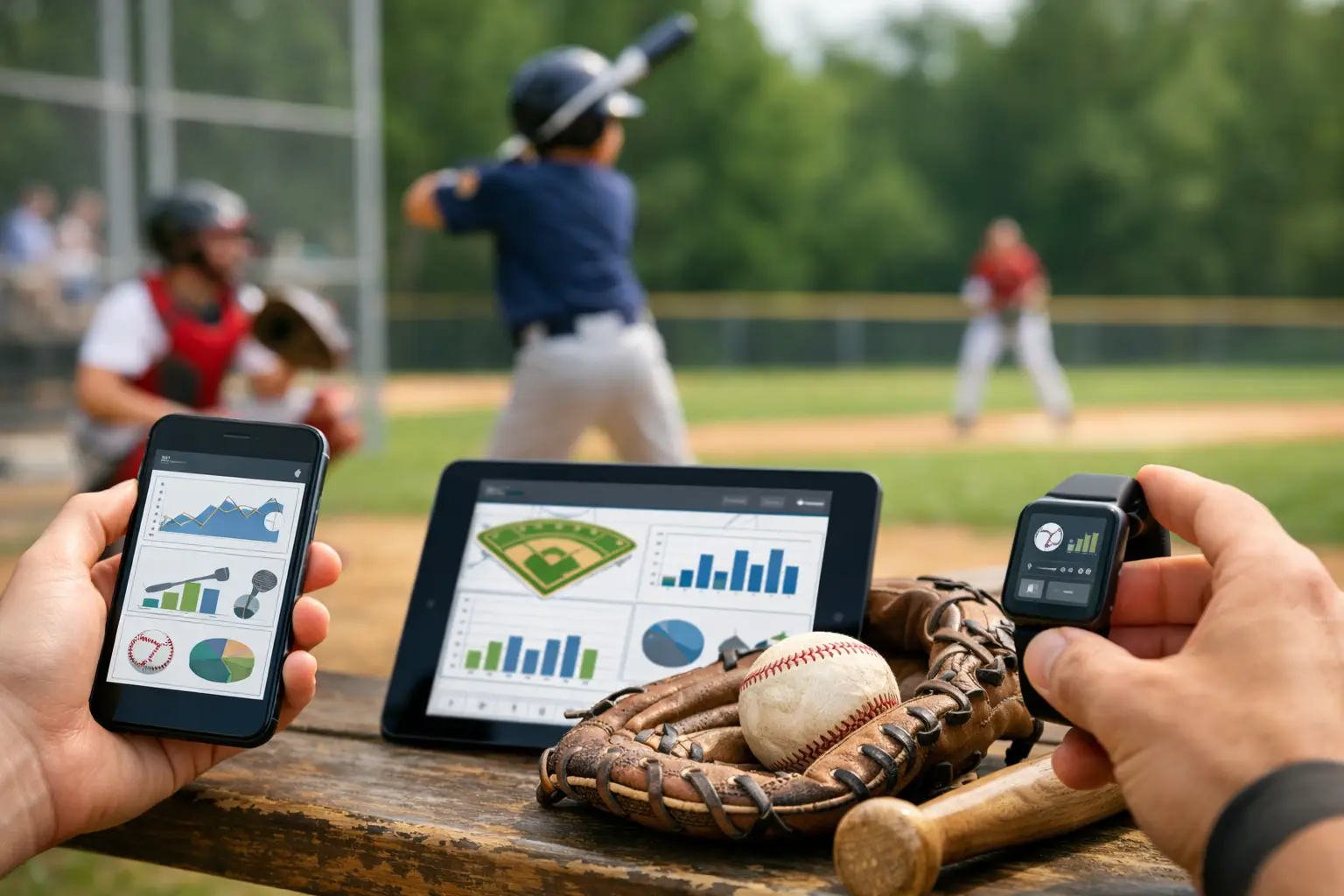
Tournament weekend tells the whole story. You are juggling game times, field changes, lineup questions, and a half-working group text, and somewhere in the middle of it all, somebody is supposed to track every at-bat and pitching stat. That is exactly where a travel baseball stats app either proves its value or becomes one more thing nobody keeps up with.
For travel ball families and coaches, the right app is not about looking fancy. It is about recording the game while it is happening, keeping stats accurate enough to be useful, and making sure those numbers still exist by midseason instead of dying in a notebook, a spreadsheet, or somebody’s phone notes app.
What a travel baseball stats app should actually do
A lot of apps promise live scoring and player stats. The real question is whether they fit how youth baseball actually works. Travel teams are not staffed like college programs. The scorekeeper is often a parent in a camp chair, a coach between innings, or a grandparent trying to help from a tablet behind the dugout.
That means the app has to be simple first. If every plate appearance takes too many taps, people stop using it. If the interface assumes expert scorekeeping knowledge, the team gets partial data at best. If the stats are trapped on one device, the whole system breaks the second the scorekeeper has to step away for a sibling’s game.
A useful app should let you score live, view updates from more than one device, and turn game input into season stats automatically. That is the baseline. Families should not have to spend extra hours rebuilding box scores later or manually calculating batting average, on-base percentage, innings pitched, strikeouts, and stolen bases after the fact.
Why travel ball makes stat tracking harder
Rec ball can be chaotic, but travel baseball adds a different kind of pressure. Teams play more games in shorter windows. Pitching limits matter. Lineups shift across pool play and bracket play. Parents want to follow along even when they cannot make every game, and coaches want enough information to spot trends before Sunday afternoon.
That makes consistency more valuable than complexity. A scorebook can work for one game. It usually does not hold up across 35, 45, or 60 games when multiple people are helping track stats. Spreadsheets have the same problem. They seem cheap and flexible until someone forgets to enter two games, formulas get changed, or one person becomes the only keeper of the file.
A good travel baseball stats app solves that by making stat collection part of the game itself, not a separate admin task. Score the action once, and the app should build the record for you.
The difference between useful stats and busywork
Not every stat is equally helpful in youth baseball. Parents and coaches do not need a mountain of data they never look at. They need stats that answer real questions.
Is a hitter putting the ball in play more often this month? Is a pitcher throwing enough strikes to work deeper into games? Who is getting on base consistently? Which players are driving the ball to different fields instead of rolling over everything to the left side? Those are practical coaching and development questions.
That is why the best tools do more than total up hits and strikeouts. They turn game events into batting splits, pitching summaries, spray charts, and clean box scores that people can read quickly. The goal is not to impress anyone with analytics language. The goal is to make performance easier to see.
For younger players especially, context matters. A stat app should help adults notice progress that can get lost in the rush of a season. One player may still be chasing their first extra-base hit, but they are cutting down strikeouts and stealing better jumps. Another may not be batting .500, but they are finding barrels more often and becoming more dependable in key spots. Good tracking keeps those improvements visible.
What to look for in a travel baseball stats app
Ease of use matters more than feature overload. If a parent can pick it up in the second inning and still keep the game correctly, that is a strong sign. If it requires a training session, it is probably not built for the bleachers.
Live access across devices is another big one. Travel baseball families are rarely all in one place. One person may score from the stands while another checks updates from another field complex. Coaches may want to review the box score after the game without waiting for someone to send screenshots. Multi-device access makes the tool practical instead of personal.
Cost also matters more than many software companies want to admit. Monthly subscriptions sound small until they stack up with tournament fees, uniforms, lessons, gas, and hotel weekends. A travel baseball stats app should save money and time, not create a new recurring bill for something a volunteer parent is running.
Permanent season history is another feature people do not fully appreciate until they lose it. Youth sports seasons move fast. A big game in April is easy to forget by June. When stats are stored properly, families can look back on real progress instead of relying on memory. That matters for player development, team communication, and honestly, for preserving moments that should not disappear.
Travel baseball stats app comparisons often miss the biggest issue
Most comparisons focus on feature count. That sounds useful, but it misses the real test. The best app is not the one with the longest list. It is the one your team will still be using in game 28.
There is always a trade-off between depth and simplicity. Some platforms are loaded with options, but that can slow down scoring and make volunteers hesitate. Others are stripped down enough to be approachable, but leave coaches wanting more than basic totals.
The sweet spot is an app that feels simple while still producing meaningful baseball output. You want scoring that is fast during live action, and stats that go beyond the bare minimum once the game ends. If you have to choose, usability wins. In youth baseball, incomplete advanced data is less valuable than consistent, accurate core tracking.
This is also where browser-based tools have a real advantage for many families. They do not force everyone into the same phone ecosystem, and they are easier to open from whatever device is already in hand. For teams with multiple helpers, that flexibility matters more than branding or app-store polish.
Why affordability is part of the product, not a side note
A lot of youth sports software is priced like every team has a dedicated operations budget. Most do not. They have volunteer coaches, parents doing their best, and a long list of expenses that already feel too high.
That is why pricing matters so much in this category. A one-time purchase is not just cheaper over time. It is easier to justify, easier to explain to families, and easier to keep using season after season. No one wants to wonder whether their stats disappear the second they stop paying a monthly fee.
That anti-subscription model is a real differentiator when it is paired with unlimited use. If families can track unlimited teams, seasons, players, and games without watching the meter run, they are much more likely to keep the record going. That consistency is what gives the stats their value.
Baseball Stats Tracker stands out here because it is built around that exact reality - score from a phone, tablet, or browser, share live updates, and keep a permanent season record without getting stuck in another subscription.
The best fit depends on who is using it
If you are a parent who mainly wants to follow your player’s season, simplicity and access are probably your top priorities. You want to score a game without feeling buried, then pull up batting and pitching stats later without extra work.
If you are a coach, you may care more about lineup decisions, pitching usage, and spotting trends over multiple weekends. That means season stats, box scores, and splits become more important.
If you are a team organizer, reliability matters most. You need something that another parent can take over if the regular scorekeeper misses a game. That usually rules out systems that are too complicated or tied to one device.
So no, there is not one perfect answer for every team. But there is a clear standard. The right travel baseball stats app should be fast enough for live game action, simple enough for volunteers, affordable enough to keep, and strong enough to turn scattered game events into a season-long record people will actually use.
Baseball families already have enough to manage. The stat tracker should not be the hard part. Pick the tool that lets you keep the game, keep the memories, and keep the numbers without turning every weekend into extra homework.
One payment. Every season.
Live scoring, automatic stats, spray charts. $39 once, no subscription.
Get Instant Access — $3930-day money-back guarantee — no questions asked.